
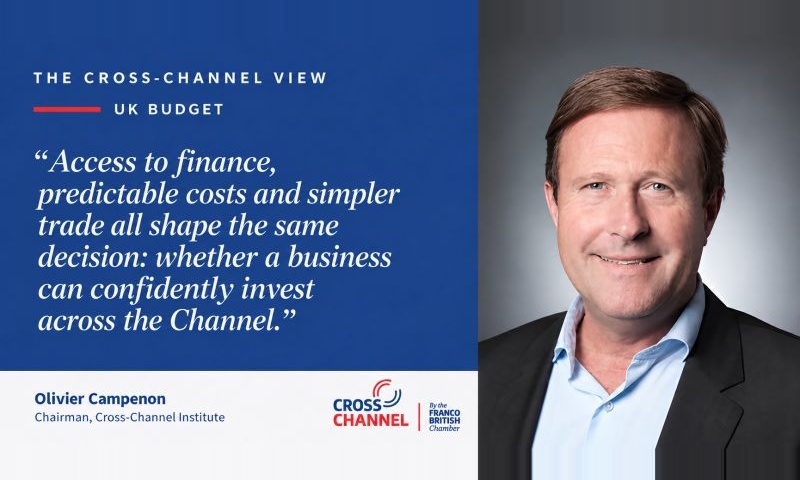
🎙️ “Access to finance, predictable costs and simpler trade all shape the same decision: whether a business can confidently invest across the Channel.”
Following today’s UK Budget, Olivier CAMPENON , Chairman of the Cross-Channel Institute, the Franco-British Chamber’s think tank, looks at the implications for businesses operating between France and the UK.
Key measures for business:
👉 Corporation tax remains capped at 25%, with full expensing maintained and the First Year Allowance raised to 50%.
👉 The British Industrial Competitiveness Scheme is confirmed: a 20–25% electricity discount for 10,000+ manufacturers from April 2027.
👉 A new Founders’ Relief, now under consultation, will offer a 10% CGT rate on up to £10m of lifetime gains for founders and early investors in high-growth companies from April 2027. Meanwhile, the Business Asset Disposal Relief lifetime limit is halved to £500,000.
👉 The National Living Wage rises 3.9% to £13.21/hour from April 2027.
👉 Up to £5bn from the National Wealth Fund and British Business Bank will target defence, dual-use and resilience sectors.
🇫🇷🇬🇧 The practical test for Franco-British businesses is how these measures translate into investment capacity and operating costs. Who qualifies, when support takes effect, and how the measures interact will decide whether companies can move forward. The Budget favours high-growth founders, while owners selling established SMEs will find the regime less generous.
Why the UK–EU reset matters: greater predictability within the UK, combined with fewer barriers between the two markets, would give businesses a stronger basis for long-term investment. The opportunity is to connect UK investment support with practical progress in the UK–EU relationship, from easier trade to closer cooperation on research, innovation and defence industrial capacity.
Source: HM Treasury — Budget 2026