




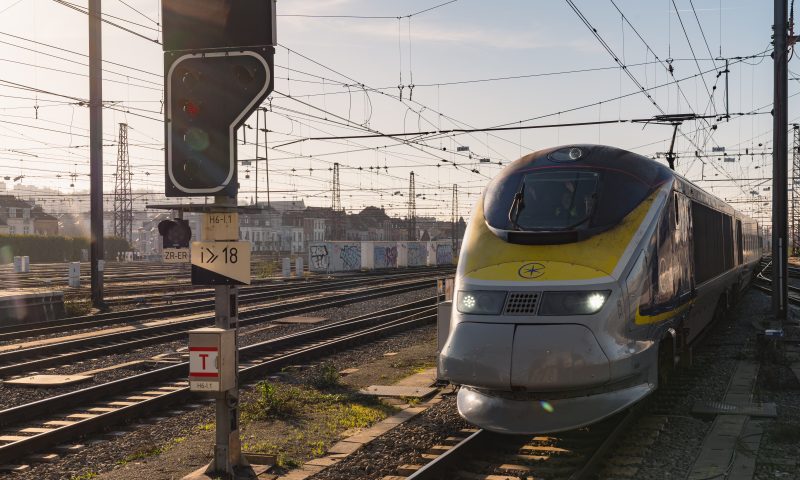
Eurostar announced that, on 6 July 2026, it received authorisation from the European Union Agency for Railways (ERA) to bring into service the first e300 trainset equipped with the ERTMS/ETCS signalling system. This approval marks a major milestone in the modernisation of Eurostar’s legacy fleet and its compliance with the highest European standards for safety and interoperability. The first commercial service operated by an ERTMS-equipped e300 train took place on Friday 17 July 2026.
The modernisation of the eight e300 trainsets completes the installation of the ERTMS/ETCS system across Eurostar’s entire fleet. This upgrade will ensure the continuity and performance of operations over the medium term by extending the operational life of the existing fleet while enhancing interoperability, at a time of growing passenger demand and increasing harmonisation of European rail systems. Gradually deployed across the continent, the ERTMS system now covers a significant proportion of the network operated by Eurostar.
The authorisation follows a rigorous process involving the conversion of a prototype trainset, which successfully completed both static and dynamic testing, carried out in partnership with MASTERIS, SNCB, and SNCF Voyageurs Matériel. With this milestone achieved, the programme enters its final phase before the progressive commercial introduction of the modernised e300 fleet. The rollout has been carefully planned to preserve commercial capacity, with only one trainset out of service at any given time.
A technological challenge successfully delivered through collaboration
Integrating the ERTMS system into the e300 fleet represented a significant technical challenge. It required the combined expertise of Eurostar’s engineering teams and its industrial partners to adapt a safety-critical technology to an existing fleet operating in a highly constrained environment at speeds exceeding 300 km/h.
Following this authorisation, Eurostar is now moving into the series production phase. Industrial operations are being carried out, in particular, at SNCB’s workshops in Namur, where the first modifications have already begun, marking the project’s transition into full-scale deployment.
Zelda Crambert, Eurostar’s Rolling Stock Director, said:
“Obtaining this authorisation demonstrates our continued commitment to safety, European interoperability and the performance of our fleet. By equipping 100% of our trains with ERTMS signalling, Eurostar is reinforcing its pioneering role as the backbone of European rail. We would like to thank all our partners for their contribution to this complex and strategically important project.”
Modernisation supporting the transition to the Celestia fleet
This programme forms part of Eurostar’s long-term industrial roadmap and paves the way for the gradual introduction of its new Celestia fleet, scheduled to enter service from 2031. The fleet will comprise up to 50 Alstom Avelia Horizon trains, representing a €2 billion investment by Eurostar.
Photo credit: Eurostar e300 train by Illias Teirlinck.